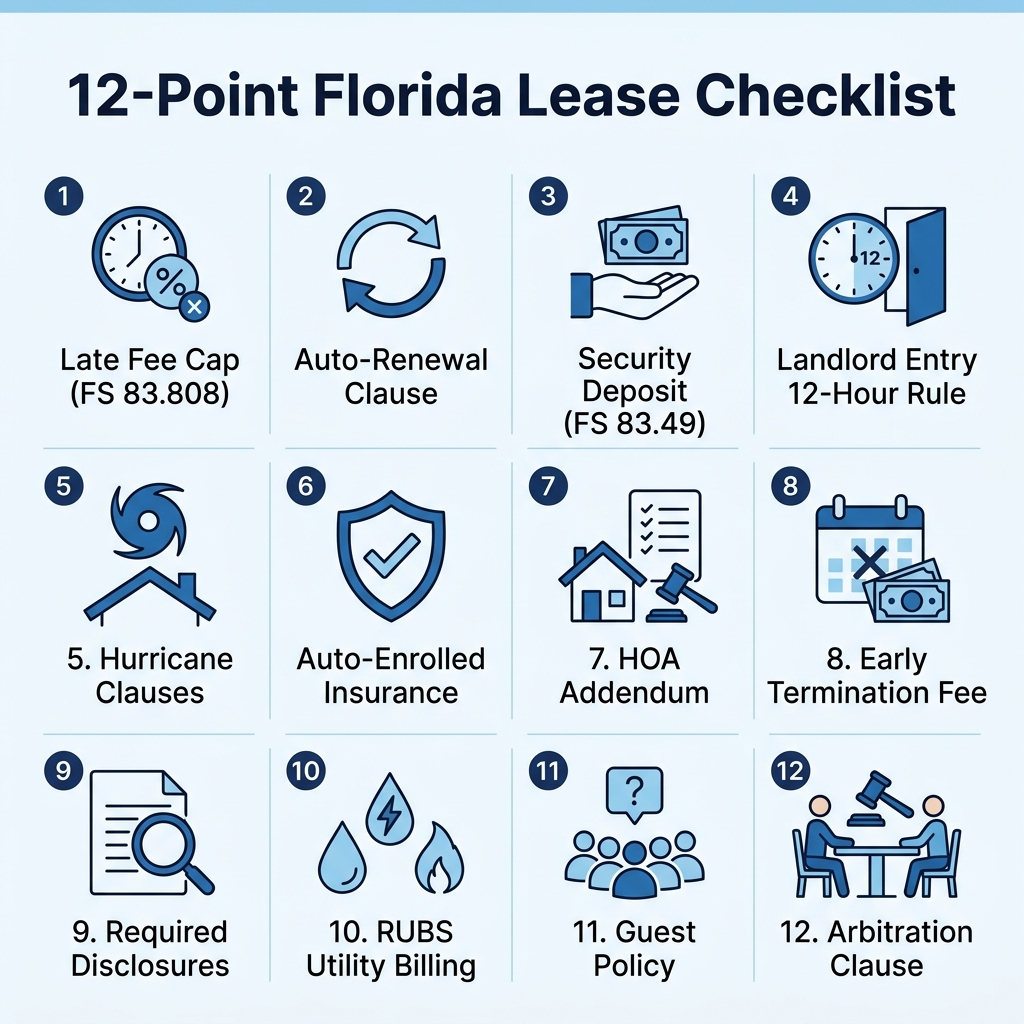
Before signing a Florida lease, review these 12 high-risk areas: (1) late fees against Florida's $20 or 20% cap (FS 83.808), (2) auto-renewal notice windows, (3) security deposit return timelines (FS 83.49), (4) the 12-hour landlord entry rule (FS 83.53), (5) hurricane and storm-damage clauses, (6) auto-enrolled renters insurance, (7) HOA addendums, (8) early termination penalties, (9) required radon (FS 83.50) and flood (FS 83.512) disclosures, (10) RUBS utility billing, (11) guest and occupancy rules, and (12) mandatory arbitration clauses. Most Florida apartment leases contain at least one term renters can negotiate before signing.

Most Florida lease signings follow the same pattern. The landlord sends the document, you have 48 hours to look at it, and somewhere between checking the rent and confirming the move-in date you decide you'll read the rest later. Then you sign. Then "later" never really comes.
It's an easy pattern to fall into, especially in Florida's fast-moving rental market where landlords aren't exactly known for giving you extra time. But Florida apartment leases carry enough state-specific quirks that going in without actually reading the document is a real financial risk. Late fees that exceed what Florida law allows, auto-renewal traps, renters insurance charges you never agreed to out loud — these aren't rare edge cases. They show up in standard Florida residential lease agreements all the time, especially in Orlando, Tampa, Miami, and Jacksonville's high-volume rental markets.
This before signing Florida lease checklist covers everything worth reviewing before you put your signature on anything. Work through it once and you'll know exactly what you're agreeing to — and which clauses you can push back on.
Why Florida Lease Fine Print Is Different From Other States
If you've rented in another state before, your Florida lease will include a few sections that look unfamiliar. That's not by accident. Florida's landlord-tenant law lives in Chapter 83 of the Florida Statutes — the Florida Residential Landlord and Tenant Act — and some of what those statutes allow is genuinely different from what you'd find in a standard residential lease elsewhere.
The Florida lease fine print is where this tends to show up. Late fee structures, security deposit language, landlord entry rights, hurricane and storm damage responsibility, auto-enrolled renters insurance — all of these look slightly different in a Florida apartment lease than in leases from Texas, New York, or California. Knowing what's standard in Florida and what crosses into predatory territory is the difference between signing confidently and signing blind.
Florida Apartment Lease Before Signing: 12-Point Checklist
Each item on this Florida lease review checklist covers a specific clause type, and each one has cost Florida renters real money when missed.
1. Check the Late Fee Amount Against Florida's Statutory Cap (FS 83.808)
Florida Statute 83.808 caps late fees at $20 or 20% of monthly rent, whichever is greater — that's the maximum your landlord can legally charge. If your lease lists a flat $150 or $200 late fee on a $1,500 rental, that exceeds Florida's late fee law and is worth questioning before you sign. The clause may still appear in your lease, but knowing the statutory cap gives you the leverage to push back or negotiate it down.
2. Review the Auto-Renewal Clause and Notice Window
Auto-renewal clauses are standard in Florida apartment leases, but the notice period varies significantly. Some leases require 30 days written notice to opt out; others demand 60 days. If you miss that window, you can be locked into another full term automatically — sometimes with a rent increase baked in. Find the renewal section, confirm the notice window in writing, and put your opt-out deadline in your calendar the day you sign.
3. Read the Security Deposit Terms (FS 83.49)
Florida Statute 83.49 requires your landlord to return your security deposit within 15 days if there are no deductions, or within 30 days with written notice if they plan to make a claim. Check that your lease accurately reflects these timelines and doesn't give your landlord more flexibility than Florida law allows.
4. Confirm the 12-Hour Landlord Entry Notice Requirement (FS 83.53)
Florida Statute 83.53 requires landlords to give at least 12 hours notice before entering your unit, except in emergencies. Check the entry section of your lease carefully. Some Florida leases include language that effectively grants broader landlord access than statute allows — open-ended entry for inspections, showings, or maintenance. If the entry clause doesn't clearly reflect Florida's 12-hour requirement, flag it before signing.
5. Look for Hurricane and Storm Damage Clauses
This section is uniquely Florida. Your lease almost certainly includes a section covering what happens during a hurricane, tropical storm, or named storm event — who's responsible for damage, whether your rent obligation continues if the unit becomes uninhabitable, and how evacuation scenarios are handled.
Hurricane Ian, Hurricane Milton, and the 2022 Florida hurricane season made this clause material for thousands of renters. It's not boilerplate. Read it carefully, and if the damage responsibility language feels one-sided, ask your landlord to clarify in writing — including whether your hurricane deductible obligation differs from a standard property loss.
6. Check for Auto-Enrolled Renters Insurance
Large apartment complexes in Orlando, Tampa, Jacksonville, and Miami increasingly bundle renters insurance as a mandatory add-on charged through your monthly rent. It's almost always tucked into an addendum at the back of the lease, not the main body.
Flip to the addenda section and look for any insurance enrollment language. If it's there, check whether you can substitute your own renters insurance policy — Florida law generally requires landlords to accept an equivalent policy of your own — and whether the monthly charge (typically $9 to $25) is clearly disclosed. Auto-enrolled building policies often cost two to three times more than what you'd pay through Lemonade, State Farm, or Allstate directly.
7. Review the HOA Addendum (If Applicable)
Florida has more HOA-governed rentals than nearly any other state — particularly in Orlando, the Treasure Coast, master-planned communities, and condo conversions. If your unit sits inside an HOA, your lease will almost certainly include an HOA addendum binding you to the association's rules.
8. Check the Early Termination Penalty
Florida law doesn't cap early termination fees by statute for standard residential leases, which means your landlord can set this at whatever they want within reason. Two months' rent is the most common early termination fee in Florida, and Florida courts have generally upheld penalties at this level. Anything significantly higher is worth negotiating before you sign rather than discovering after you need to leave early. Locate the early termination section and make sure the fee is clearly stated — not left open-ended.
9. Verify Required Florida Lease Disclosures
Florida law requires landlords to make specific disclosures in or alongside the lease:
- •Radon gas disclosure under Florida Statute 83.50
- •Flood zone disclosure under Florida Statute 83.512 (mandatory for leases signed after October 1, 2024)
- •Security deposit holding disclosure under Florida Statute 83.49
- •Federal lead-based paint disclosure for any unit built before 1978
If your lease is missing any of these required Florida lease disclosures, that's a meaningful flag — not because it changes your decision automatically, but because a landlord skipping mandatory disclosures may be cutting other corners too.
10. Verify Utility Responsibility and RUBS Billing
Who pays for water, sewer, trash, pest control, and lawn maintenance in your Florida rental? Many large apartment complexes structure these as landlord-provided utilities passed through tenants via a RUBS (Ratio Utility Billing System) arrangement, which means your "fixed" rent isn't actually fixed — your monthly utility allocation can fluctuate based on building-wide usage. Find the utility responsibility section and confirm exactly what you're responsible for, whether any charges fluctuate, and whether your unit is individually metered or RUBS-allocated.
11. Read the Guest and Occupancy Policy
Some Florida apartment leases include guest policies stricter than most renters expect — limiting how long a guest can stay before they need to be added to the lease, or requiring advance written notice for extended visitors. UCF Student Legal Services has flagged that some Orlando-area leases trigger occupancy violations after as few as seven consecutive nights. If you regularly host family or partners, this section matters more than it appears at first read.
12. Check for Mandatory Arbitration Clauses
A mandatory arbitration clause forces you to resolve any landlord dispute through arbitration rather than the courts. These clauses are legal in Florida residential leases, but they significantly limit your options if something goes wrong — including small claims for security deposit disputes. If there's an arbitration clause in your lease, know it's there before you sign so you understand the dispute resolution process.
Florida Lease vs Standard Lease: What's Different
Florida-specific clauses every renter from out of state should know about:
| Clause | Florida Standard | Out-of-State Comparison |
|---|---|---|
| Late fee cap | $20 or 20% of rent (whichever is greater) — FS 83.808 | Varies; many states have no cap or % cap only |
| Security deposit return | 15 days (no deductions) / 30 days (with claim) — FS 83.49 | Often 14 to 60 days |
| Landlord entry notice | 12 hours — FS 83.53 | Typically 24 hours |
| Hurricane / storm clause | Standard in nearly every Florida lease | Rare or absent |
| Auto-enrolled renters insurance | Common in large complexes | Less common |
| HOA addendum | Frequent in master-planned areas | Less prevalent |
| Flood disclosure | Required — FS 83.512 (effective Oct 2024) | Varies by state |
The Fastest Way to Get Through Florida Lease Fine Print
Reading a 25-page Florida apartment lease cover to cover is genuinely tedious, and if you're doing it the night before your signing deadline you'll start skimming halfway through. That's when things get missed.
The 12-point checklist above is built to focus your attention on the sections that carry the most financial and legal risk. Work through those specifically rather than absorbing every paragraph in order. If you find something that doesn't look right — a late fee that exceeds Florida's $20 or 20% cap, entry language broader than 12 hours, an auto-enrolled insurance policy you weren't told about — flag it and ask your landlord to clarify or revise the clause before you sign.
Most Florida landlords will negotiate at least some of these items, especially if you're otherwise a strong applicant. The mistake most renters make is assuming the lease is final as presented. It rarely is.
Frequently Asked Questions
What should I check on a before signing Florida lease checklist?▾
What is the Florida lease fine print I should pay closest attention to?▾
Can I negotiate a Florida lease before signing?▾
Which lease clauses may be unenforceable in Florida?▾
Does Florida law require renters insurance?▾
How long does it take to properly review a Florida lease?▾
What do I need to review on a Florida apartment lease before signing?▾
Check Your Own Lease Now
Everything in this guide applies to leases in general — but your lease may have specific clauses that need their own review. Upload it free.
Analyze My Lease — FreeExplore everything LeaseGuard AI offers on the LeaseGuard AI homepage.