
A lease can lock you into six to twelve months. A month-to-month rental can give you room to move, but it may change with proper notice. Here are the best agreement options for U.S. renters, plus the clauses that deserve a close look before you sign.
1. LeaseGuard AI
LeaseGuard AI is an AI-powered lease reviewer for renters who want plain answers before signing.
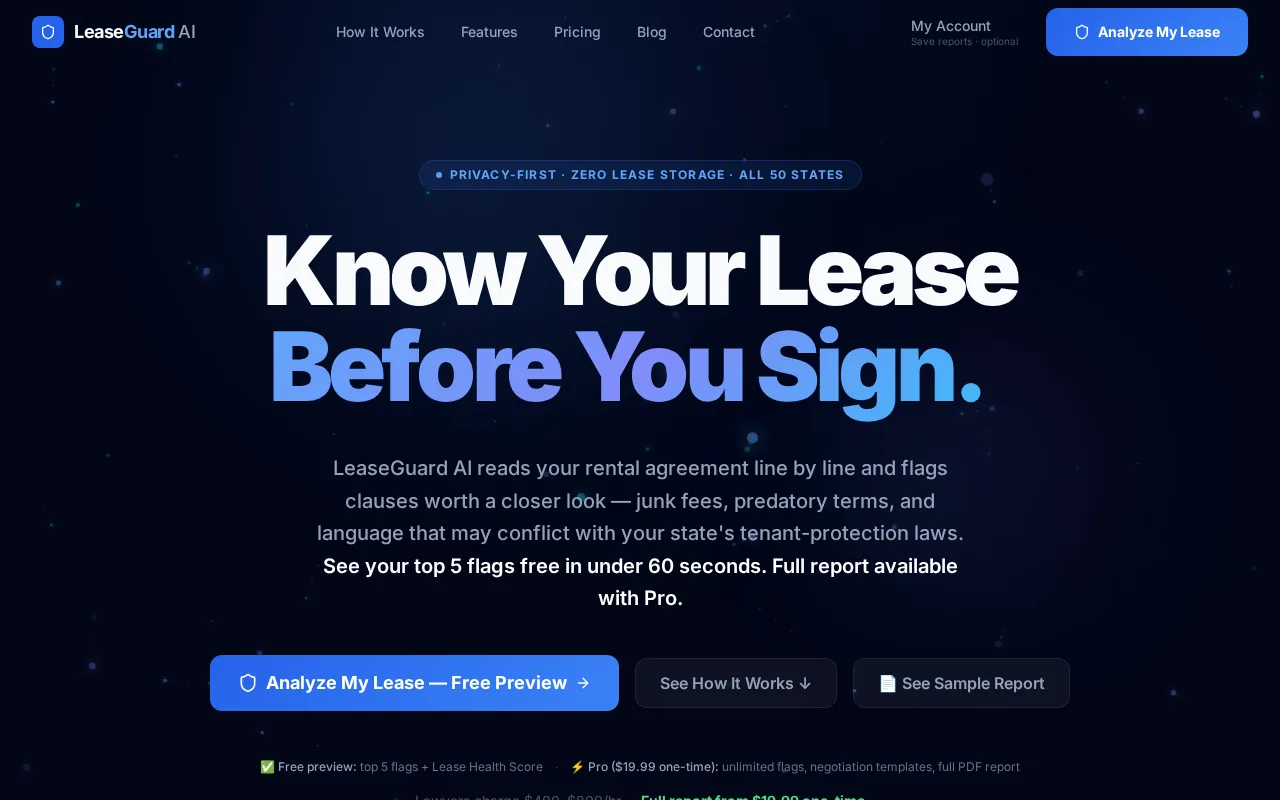
It fits best when you already have a lease in hand and want to spot costly terms before you commit. Upload a PDF or DOCX file, get a free risk preview, then review a fuller report that explains items such as early termination fees, automatic renewal language, rent increase clauses, hidden fees, and deposits.
The service also estimates what certain clauses could cost. That matters when a lease says you may owe one or two months of rent for moving out early. You can see the term, the possible cost, and the point that may be worth asking the landlord to change.
Most analyses take two to four minutes. You don't need an account to upload a lease.
LeaseGuard AI doesn't replace a lawyer or tell you that a clause is legal in your state. It gives you a clearer starting point for questions and negotiation. See how LeaseGuard AI reviews residential leases before you sign.
LeaseGuard AI provides informational analysis only; it is not a law firm.
2. Month-to-Month Rental Agreement, Best for Maximum Flexibility
A month-to-month rental agreement renews for each month instead of ending on one fixed date.

It's best for renters who may move soon, are between homes, or don't want to make a year-long promise. It can also suit someone testing a new job or city before settling down.
The main benefit is freedom. Either side can usually end the arrangement with the notice required by the agreement and state law. A landlord may also change the rent or other terms after giving proper notice. Many areas use a notice period near 30 days, but that isn't a nationwide rule.
The tradeoff is less certainty. Your rent may rise after notice. The landlord may decide not to continue the tenancy. You also face more frequent renewal decisions than you would under a fixed lease.
Don't assume the shorter term means a smaller deposit. A security deposit usually stays in place for the full tenancy. It can still cover unpaid rent, damage, or lease violations, subject to state rules.
Choose this option when flexibility matters more than a locked rent amount. Read the notice clause before you move in.
3. Duration: Fixed-Term Lease vs. Short-Term Rental
A lease usually has a fixed term, typically 6–12 months or longer, with a set start and end date.

A short-term rental agreement is usually month-to-month and has no defined end date. This arrangement may be better when you need more flexibility.
Because a lease has set terms, it is generally less flexible. A short-term rental agreement offers more flexibility, allowing changes as needed.
Review the agreement for its start date, end date, and renewal terms before signing. The duration affects how long you can stay and how easily the arrangement can change.
LeaseGuard AI provides informational analysis only; it is not a law firm.
4. Flexible Rental Terms, Best When Circumstances May Change
Flexible rental terms can offer high flexibility, allowing landlords to make changes and adapt as needed.

A short-term arrangement is usually month-to-month, with no defined end date.
Because the terms can change, renters should review the agreement carefully before signing. Ask how proposed changes will be communicated and when they take effect.
Renters should also confirm the current rent and any other key terms in writing. Clear documentation can make changes easier to track.
LeaseGuard AI provides informational analysis only; it is not a law firm.
5. Renewal Process for Leases and Rental Agreements
A lease has a set start and end date. Once the tenancy ends on the agreed-upon date, landlords and tenants must negotiate and sign a new lease agreement.

A rental agreement typically renews each month automatically until either party provides notice. This can offer more flexibility when you do not want to commit to a new fixed term.
Review the agreement for its renewal process and notice requirements. Lease wording matters when it explains what happens at the end of the term and whether a new agreement is required. Review this state statute for an example.
Before signing, mark the lease end date or monthly notice requirements on your calendar. Then ask what happens when the current term ends.
6. Renewal Process, What Happens When a Fixed Term Ends
A fixed-term lease has a set start and end date, typically lasting 6–12 months or longer.

Once the tenancy ends on the agreed-upon date, the landlord and tenant must negotiate and sign a new lease agreement.
A rental agreement usually works differently. It renews each month automatically until either party provides notice.
This means a lease has a defined end date, while a month-to-month rental agreement has no defined end date. The renewal process can affect how much flexibility you have when deciding whether to continue.
If you are comparing these arrangements, review the agreement for its term length and renewal language before signing. LeaseGuard AI is an AI-powered lease-review service that can help you understand those terms.
If you are considering leaving, review the guide to getting out of a lease agreement.
LeaseGuard AI provides informational analysis only; it is not a law firm.
7. Duration and Term Length
Duration is one of the clearest differences between a lease and a rental agreement. A lease is usually for 6 to 12 months of residency, while a month-to-month rental agreement may be better for a situation that calls for a shorter commitment.

A lease generally has a fixed term, typically 6–12 months or longer, with a set start and end date. A short-term rental arrangement is usually month-to-month and has no defined end date.
Flexibility also depends on the duration. Because a lease has set contract terms, leases aren't flexible. A month-to-month arrangement offers high flexibility, allowing landlords to make changes and adapt as needed.
Rent treatment can differ as well. Rent stays fixed for the entire lease term unless the agreement has a clause permitting mid-lease rate adjustments, which is not that common.
Before signing, compare the duration, start date, end date, and flexibility with your plans. LeaseGuard AI can help you review the language so the term is easier to understand. Your lease addendum review guide explains why added terms deserve the same care.
A security deposit protects landlords against unpaid rent, damage, and lease violations. For a lease, the deposit lasts for the lease's term and is settled at move-out. Check your state laws for security deposit limits.
8. Rental Agreement Duration
A rental agreement is often short term, usually month-to-month, with no defined end date.

That structure may be better when a renter does not want a fixed end date. A lease, by contrast, is usually for 6 to 12 months of residency.
More specifically, a fixed-term lease typically lasts 6–12 months or longer and has a set start and end date. A short-term rental agreement is usually month-to-month and has no defined end date.
Because lease terms are set, leases aren't flexible. Rental agreements offer high flexibility, allowing landlords to make changes and adapt as needed.
Before choosing, compare the agreement's duration and flexibility. LeaseGuard AI is an AI-powered lease-review service. LeaseGuard AI provides informational analysis only; it is not a law firm.
9. Sublease Agreement, Best for Temporary Occupancy Changes
A sublease agreement lets the original tenant rent the home to another person for part of the lease term.

It's best when you need to leave for a limited time but want to keep the right to return. A student, worker, or renter caring for family may consider this path.
Start with the main lease. It may ban subleasing or require the landlord's written approval. The original tenant often remains responsible to the landlord even after a subtenant moves in.
The sublease should state the dates, rent, deposit, utilities, house rules, damage duties, and move-out condition. Give the subtenant a copy of the main rules that apply to them. Do not promise rights you don't have.
Also check how the deposit works. A landlord may hold the original deposit while the original tenant collects a separate amount from the subtenant. That arrangement needs clear records.
Use written approval where required. A side deal can leave you owing rent after you thought the problem had moved to someone else.
10. Security Deposit
A security deposit protects landlords against unpaid rent, damage, and lease violations.

For a lease, the deposit lasts for the lease’s term and is settled at move-out. The lease term determines how long the deposit remains in place before that settlement.
When reviewing a lease, identify the security deposit terms and the protections it provides against unpaid rent, damage, and lease violations.
The deposit is connected to the lease term. It remains in place during that term and is settled when the tenant moves out.
Check your state laws for security deposit limits. State limits are an important part of reviewing the deposit terms before agreeing to the lease.
The key points are what the deposit protects, how long it lasts, and when it is settled at move-out.
Lease vs Rental Agreement: Side-by-Side Comparison for U.S. Renters
The lease vs rental agreement choice usually comes down to stability or flexibility. Both can create serious financial duties, and both may require a security deposit for the full time you occupy the home.
| Decision point | Fixed-term lease | Short-term rental arrangement |
|---|---|---|
| Typical duration | Six to twelve months or longer, with a set start and end date | Often month-to-month, with no fixed final date |
| Rent stability | Usually stays fixed during the term unless the document allows a change | May change after the required notice |
| Moving out | Early departure may trigger a fee or continued rent duty | Usually requires notice before the next rental period ends |
| Renewal | May require a new lease or may renew under a stated clause | Usually renews automatically each period |
| Security deposit | Held during the lease and settled after move-out, subject to state law | Held during the tenancy and settled after move-out, subject to state law |
| Best fit | Stable housing and predictable rent | Shorter plans and easier changes |
| Main renter risk | Being tied to a costly term | Rent changes or a shorter notice window |
For a lease, inspect the early-termination clause first. Look for a fixed fee, rent owed until re-rented, a duty to pay marketing costs, or a requirement to find a replacement tenant.
For a short-term rental arrangement, inspect the notice and rent-change clauses. Confirm how notice must be delivered. Check whether the agreement states a different period from the state default.
State law can change the result. Deposit limits, notice periods, repair duties, eviction rules, and just-cause protections differ across the United States. A general comparison cannot replace the rule for your property.
One fact surprises many renters: a month-to-month arrangement does not usually remove the deposit. The deposit still protects against unpaid rent, damage, and lease violations during the tenancy. Shorter duration does not automatically mean lower move-in risk.
LeaseGuard AI provides informational analysis only; it is not a law firm.
FAQ
What is the main difference between a lease and a rental agreement?
The main difference is the term length and how the arrangement renews. A lease usually has a fixed start and end date, while a rental agreement often renews month by month. A lease gives more rent stability, but it can cost more to leave early. A rental agreement gives more flexibility, but rent or occupancy may change after proper notice.
Is a lease cheaper than a month-to-month rental?
A lease isn't always cheaper, but it often gives you a more predictable rent amount during the fixed term. Month-to-month housing may cost more because you pay for flexibility, though pricing depends on the property and local market. Compare the full deal, including deposits, fees, utilities, renewal terms, and early-move costs.
Can a landlord raise rent during a lease?
A landlord usually can't raise rent during a fixed lease unless the agreement includes a valid rent-change clause or the parties agree to a change. A month-to-month rental may allow a rent increase after the notice required by state and local law. Read the rent section and check the law where the property is located.
Does a month-to-month agreement require a security deposit?
A month-to-month agreement may require a security deposit, just like a fixed lease. The deposit usually stays in place for the tenancy and can cover unpaid rent, damage, or lease violations, subject to state limits and refund rules. Short duration alone doesn't cancel the deposit requirement.
What happens when a lease ends?
When a lease ends, the tenancy may end, renew for another fixed term, or convert to month-to-month. The answer depends on the lease language, the parties' actions, and state law. Check for automatic renewal and holdover clauses well before the end date. Ask for written confirmation if the next arrangement isn't clear.
Is a verbal rental agreement valid?
A verbal rental agreement can be valid in some U.S. situations, but proof is much harder when the terms are disputed. State law may require a writing for certain leases or terms. If you have a spoken deal, confirm the rent, term, deposit, repairs, and notice rules in writing as soon as possible.
Conclusion
Choose a fixed lease if stable rent and a known end date matter most. Choose a recurring rental if you need room to move and can handle possible changes. Before signing either one, upload the document to LeaseGuard AI for a plain-language risk review, then raise any unclear fee, renewal rule, or early-termination clause with the landlord.
This article is general information, not legal advice. Laws vary by state — verify details with your state's landlord-tenant statutes or a licensed attorney.
Check Your Own Lease Now
Everything in this guide applies to leases in general — but your lease may have specific clauses that need their own review. Upload it free.
Analyze My Lease — Free